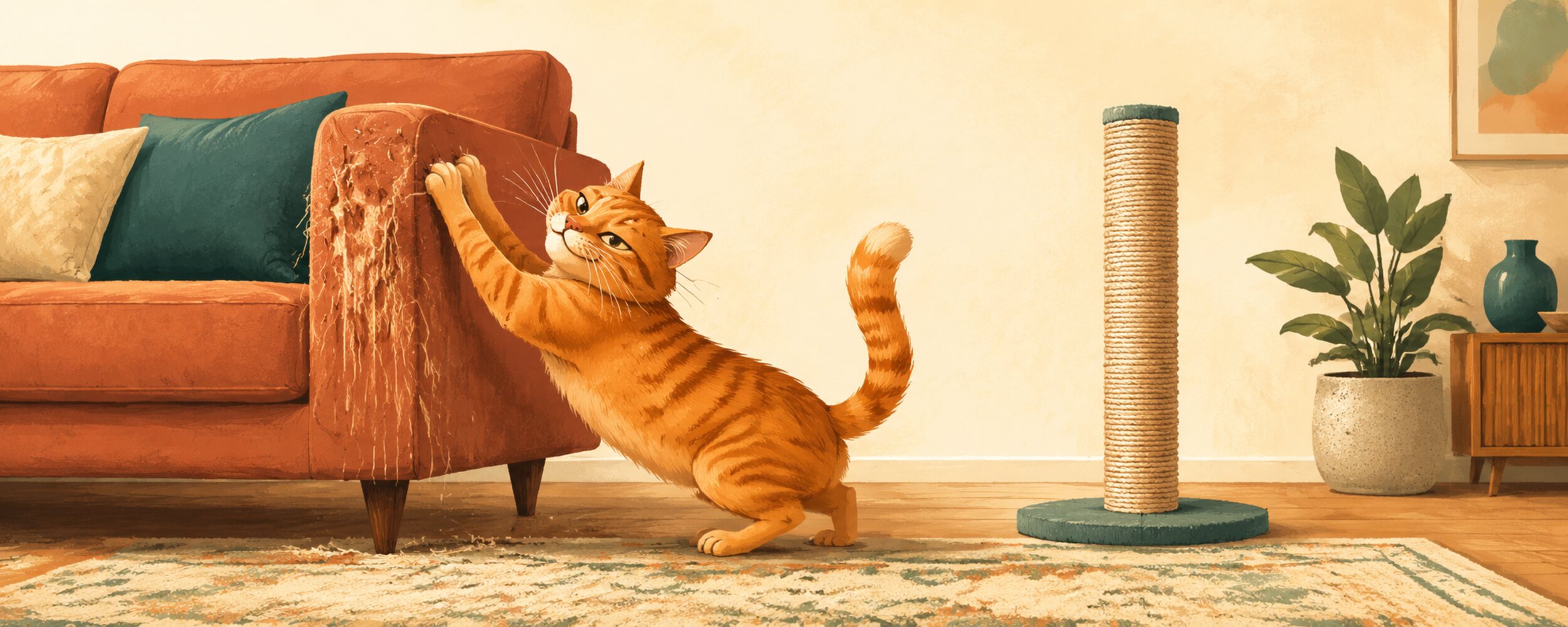
You bought a scratching post. Your cat inspected it for three seconds, walked past it, and returned to the couch like a tiny contractor finishing an important demolition job.
That does not mean your cat is stubborn, spiteful, or impossible to train. It usually means the couch is better at being a scratching post than the scratching post is.
From your cat’s perspective, the couch may be tall enough for a full-body stretch, heavy enough not to wobble, covered in a satisfying fabric, and positioned in one of the most socially important rooms in the house. The actual scratcher may be short, unstable, tucked into a quiet corner, or made from a texture your cat does not enjoy.
The couch is not just the problem. It is also the clue.
Scratching is not a bad habit
Cats scratch to maintain their claws, stretch their bodies, and leave both scent and visible marks in their environment. It is normal behavior, not a rule they have decided to break.
That distinction matters because the goal is not to make a cat stop scratching. It is to give the behavior a better destination.
Punishment works against that goal. Yelling, spraying water, or frightening a cat away from the couch does not make the need to scratch disappear. It can add anxiety, and anxiety can increase marking behavior. At best, the cat learns not to scratch when you are watching.
A more useful question is: what does this exact part of the couch provide that the scratcher does not?
Let the damaged spot answer the question
Before buying another highly rated scratching post, watch how your cat uses the furniture.
If your cat stands on the floor and reaches high up the couch arm, they may want a vertical surface that allows a complete stretch. A short post forces them to crouch and cannot compete. A vertical scratcher should be sturdy and extend beyond the cat’s stretched-out height; if it rocks, slides, or begins to tip, the couch wins immediately.
If your cat scratches the seat, rug, or carpet, they may prefer a horizontal surface. If they work along a sloping edge, an angled scratcher may feel more natural. Cats can prefer vertical, horizontal, or angled surfaces, and that preference can matter more than whether a product is marketed as universally appealing.
Then look at texture. A cat choosing a tightly woven couch corner is giving you different information from one pulling at a soft carpet or shredding cardboard. Common preferences include sisal rope, cardboard, carpet or rough fabric, and wood. Sisal is a useful starting point, but it is not a law. The best material is the one your cat repeatedly chooses.
Finally, notice where the scratching happens. A scratcher hidden in a spare room is not an alternative to a couch in the center of family life. Scratching can leave territorial and scent signals, so location is part of the behavior—not an interior-design detail you can ignore.
In other words, do not shop for the prettiest scratcher. Reverse-engineer the couch.
Build a competitor the couch might actually lose to
Start by placing the new scratcher directly in front of the couch area your cat uses. This may look awkward for a while, but a beautiful post across the room is useless if the cat wants to scratch here.
Match the setup as closely as practical:
- For a couch arm, use a tall, stable vertical post or a scratcher that wraps around the arm.
- For carpet scratching, try a flat cardboard, carpet, or rough-fabric surface that cannot slide.
- For a cat that alternates between positions, offer more than one orientation rather than expecting a single product to serve every purpose.
- If scratching often happens after naps, place another suitable surface near the cat’s sleeping area.
The Feline Veterinary Medical Association recommends providing a variety of scratcher shapes and materials and placing them near sleeping areas or directly in front of a preferred but unwanted scratching spot. Multiple useful scratchers in the places a cat already spends time are more valuable than one elaborate cat tree in the wrong room.
Once your cat uses the new surface, reward that choice immediately with something they genuinely like: a small treat, play, petting, or catnip if they respond to it. Catnip is not a universal solution—young kittens and some adult cats do not respond—so a blank reaction does not mean the scratcher has failed.
You can also make the couch temporarily less satisfying while the replacement becomes familiar. Furniture covers, two-sided sticky tape, or a scratcher mounted over the targeted couch arm can help, provided the material is safe for your cat and the change does not frighten or hurt them. If your cat chews plastic, do not use plastic coverings they can access.
The sequence matters: first provide the right alternative, then reduce access to the old one. Simply blocking the couch without meeting the same scratching need may send the cat searching for another piece of furniture.
When the pattern changes suddenly
A long-standing preference for one couch corner is usually a setup problem. A sudden increase in scratching, scratching in several new locations, or a major change after a move, renovation, new pet, schedule disruption, or the appearance of outdoor cats may point to stress or territorial pressure.
Age can change the physical side of the equation too. A senior cat that once used a vertical post but begins choosing horizontal surfaces may find the new position easier. If a scratching preference changes abruptly—especially alongside changes in movement or other behavior—bring it up with a veterinarian rather than treating it as disobedience.
The behavior is still information. The question has simply changed from “Which scratcher does this cat prefer?” to “Why did this cat’s preference change?”
The best scratching post is not the highest-rated one
It is the one that solves the same problem the couch currently solves.
That might mean a tall sisal post planted directly beside the damaged arm. It might mean a horizontal cardboard pad where the cat wakes up. It might mean several inexpensive scratchers in meaningful locations instead of one premium tower nobody touches.
Your cat has already completed the product test. The scratched surface tells you the preferred position, location, resistance, and texture.
The couch is not winning because your cat loves chaos. It is winning because, so far, it is the better scratching post.
Sources
- Feline Veterinary Medical Association, Scratching Resources
- Feline Veterinary Medical Association, Setting Up the Environment for Success
- Feline Veterinary Medical Association, It’s Natural for Cats to Scratch!
- Feline Veterinary Medical Association, Claw Counseling: Helping Clients Live Alongside Cats with Claws