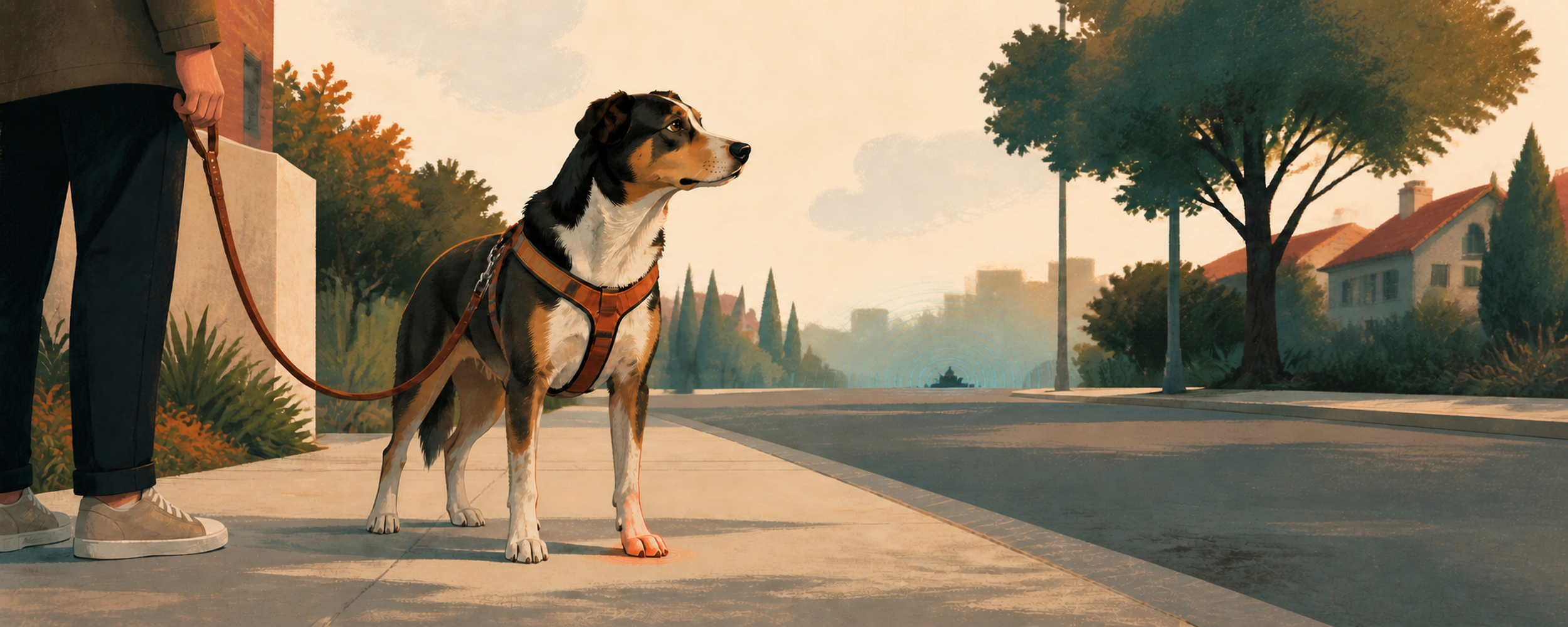
Yesterday your dog pulled you toward the park. Today, they stop at the front door and lean backward against the leash. Or they walk half a block, plant all four feet, and refuse to take another step.
It is easy to call this stubbornness, especially when the dog eventually moves for a good enough treat. But a sudden refusal to do something familiar is not a useful moment to test who is in charge. It is information. The dog may be avoiding pain, uncomfortable equipment, a frightening part of the environment, or some combination of the three.
The word suddenly matters here. A puppy who has never learned to walk on leash presents a different problem from an adult dog who enjoyed the same route until this week. When a familiar behavior changes, start by asking what changed for the dog.
First, stop trying to win the walk
Do not drag the dog forward or keep tightening the leash until they move. That may get you several feet farther, but it tells you nothing about the cause. If the dog is hurting, force adds pain. If the dog is afraid, it removes the option to get away and can make the place, equipment, or walk itself feel less safe next time.
Move to a safe spot if you are near traffic. Loosen the leash and give the dog a moment. If they want to turn home and can do so safely, let them. A shortened walk is a small cost compared with turning one alarming experience into a repeated struggle.
Then look at where the refusal begins. Does the dog avoid the harness before you leave? Stop at the threshold? Freeze at one corner? Walk normally until the route reaches a particular surface or sound? Lag only after several minutes? The pattern helps separate possible causes.
Check for discomfort before treating it as a training problem
Pain in dogs is not always announced by crying or an obvious limp. It can appear as reluctance to move, a slower pace, stopping on walks, difficulty rising, hesitation on stairs, reduced jumping, restlessness, or a change in personality. A dog can also move normally for a short distance and stop once an uncomfortable area has been used enough to hurt.
Before the next walk, observe your dog indoors. Compare their movement with their usual baseline:
- Do they rise from bed normally?
- Are they avoiding stairs, the car, furniture, or slippery floors?
- Are they shifting weight away from one leg or taking shorter steps?
- Are they licking one paw or another part of the body repeatedly?
- Has their appetite, energy, sleep, or tolerance of touch changed?
Check the paws visually, including the pads, nails, and spaces between the toes. Look for a torn nail, cut, redness, swelling, debris, or a tender-looking area. Do not squeeze, bend, or probe a painful limb. A dog in pain may bite even if they have never bitten before.
Consider the walking surface too. Hot pavement can injure paw pads, while ice, road salt, sharp gravel, or a newly slippery floor can make movement painful or insecure. If the refusal appears only on one kind of surface, that detail matters.
Next, inspect the equipment. A harness can twist, pinch, rub behind the front legs, or restrict the shoulders. Fit can change after weight gain, weight loss, grooming, or growth. Watch the dog walk in the harness and check for chafing, hair loss, pressure points, or shortened front-leg movement. Also notice whether the reluctance starts when the harness appears or only after it is fastened. The problem may be the fit, the handling required to put it on, or an association formed during an earlier uncomfortable walk.
Finding nothing at home does not rule out pain. Subtle orthopedic, spinal, neurological, or internal discomfort cannot be diagnosed by looking at the paws. A sudden and persistent change deserves a veterinary examination, particularly if there is no clear environmental trigger.
Fear can look like a dog “putting on the brakes”
A frightened dog does not always bark, bolt, or hide. Freezing is also a fear response. On a walk, that may look like a lowered body, tucked tail, ears held back, head turning away, lip licking, scanning the surroundings, trembling, or panting when the dog is not hot. Some dogs simply become very still.
Look for what happens immediately before the stop. Common triggers can include construction noise, trucks, unfamiliar dogs, people, flags, wheeled objects, a garbage collection route, a slippery patch, or a location where something frightening happened before. Humans often miss the connection because the original event seemed minor or occurred several days earlier.
Location is useful evidence. A dog who stops at the same corner may be reacting to something associated with that place. A dog who refuses only after dark may be responding to reduced visibility or a different set of sounds. A dog who walks away from home but stops when the route turns toward a busy street may be trying to increase distance from that environment.
Food can help reveal intensity, but it is not a verdict. A dog who normally takes treats but cannot eat near the trigger may be too distressed to learn there. A dog who follows a piece of chicken forward is not necessarily comfortable; the food may simply be competing successfully with fear for a few seconds. Watch the whole body, not just whether the dog moves.
Pain and fear can also become linked. A sore dog may slip on a particular surface, feel pain when a harness tightens, or hurt halfway around a route. Even after the original pain improves, the dog may hesitate because that context now predicts discomfort. This is why a veterinary check and behavior work are sometimes both necessary.
What to do on the next few outings
If the dog can stand and walk comfortably, has no urgent warning signs, and seems worried about a specific part of the environment, make the next outing easier rather than longer.
Choose a quieter time or a shorter route. Keep enough distance from the suspected trigger that the dog can look at it without freezing or trying to escape. Let the dog sniff and choose the pace. If their body tightens, they stop taking food, or they try to retreat, increase the distance. The goal is not to prove they can endure the trigger. It is to keep them feeling safe enough to form a different association over time.
Do not use leash corrections, scolding, or repeated forced exposure. For a dog who is afraid, those methods can add another unpleasant event to an already difficult situation. If the problem continues after medical causes have been addressed, ask your veterinarian for a referral to a qualified reward-based trainer or a board-certified veterinary behaviorist.
While you investigate, replace missed walking time with activities the dog can do comfortably: sniffing in the yard, searching for scattered food indoors, food puzzles, or short training games. Exercise matters, but a walk is not the only way to provide activity and enrichment.
Give your veterinarian a pattern, not just “my dog won’t walk”
Record a short video if you can do so without prolonging the dog’s distress. Note the time, weather, surface, route, equipment, how far the dog walked, what happened immediately before the stop, and how quickly they returned to normal afterward. Also record changes at home, even if they seem unrelated.
This information can make a veterinary visit more productive. A dog may move differently in the clinic because of excitement or stress, while a video captures the behavior in its usual setting. A simple log can also reveal that the refusal happens only in heat, only with one harness, after a certain distance, or alongside changes in stairs and jumping.
Contact your veterinarian promptly when the refusal is sudden, persists, recurs, or comes with limping, stiffness, sensitivity to touch, appetite changes, unusual fatigue, restlessness, or other behavior changes. Seek urgent or emergency veterinary care if your dog cannot stand or walk without assistance, has an obvious fracture, has experienced major trauma, collapses, or has labored breathing. If you are unsure which level of care is appropriate, call your veterinary clinic or the nearest emergency hospital and describe what you see.
Do not give a dog aspirin, ibuprofen, naproxen, acetaminophen, leftover medication from another pet, or any other pain reliever unless your veterinarian directs you to. Drugs and doses used safely in people may cause serious harm in dogs or interfere with the treatment your veterinarian chooses.
A dog who stops walking is not explaining the cause. But they are communicating that continuing feels difficult, unsafe, or painful. Treat that change as a clue rather than a challenge, and you are more likely to find the real problem before it becomes a larger one.
Sources
- American Animal Hospital Association, What’s Wrong? Common Pet Pain Signs
- American Animal Hospital Association, Chronic Pain Assessment in Dogs
- American Animal Hospital Association, How to Protect Your Dog’s Paws from Hot Pavement
- VCA Animal Hospitals, Urgent Care for Pain or Limping
- VCA Animal Hospitals, Fears, Phobias, and Anxiety in Cats and Dogs
- Dogs Trust, How to Train Your Dog to Wear a Harness
- American Veterinary Society of Animal Behavior, If Your Dog Is Afraid, Avoid These Two Mistakes
- American Veterinary Society of Animal Behavior, Humane Dog Training Position Statement
- U.S. Food and Drug Administration, Frequently Asked Questions About Animal Drugs