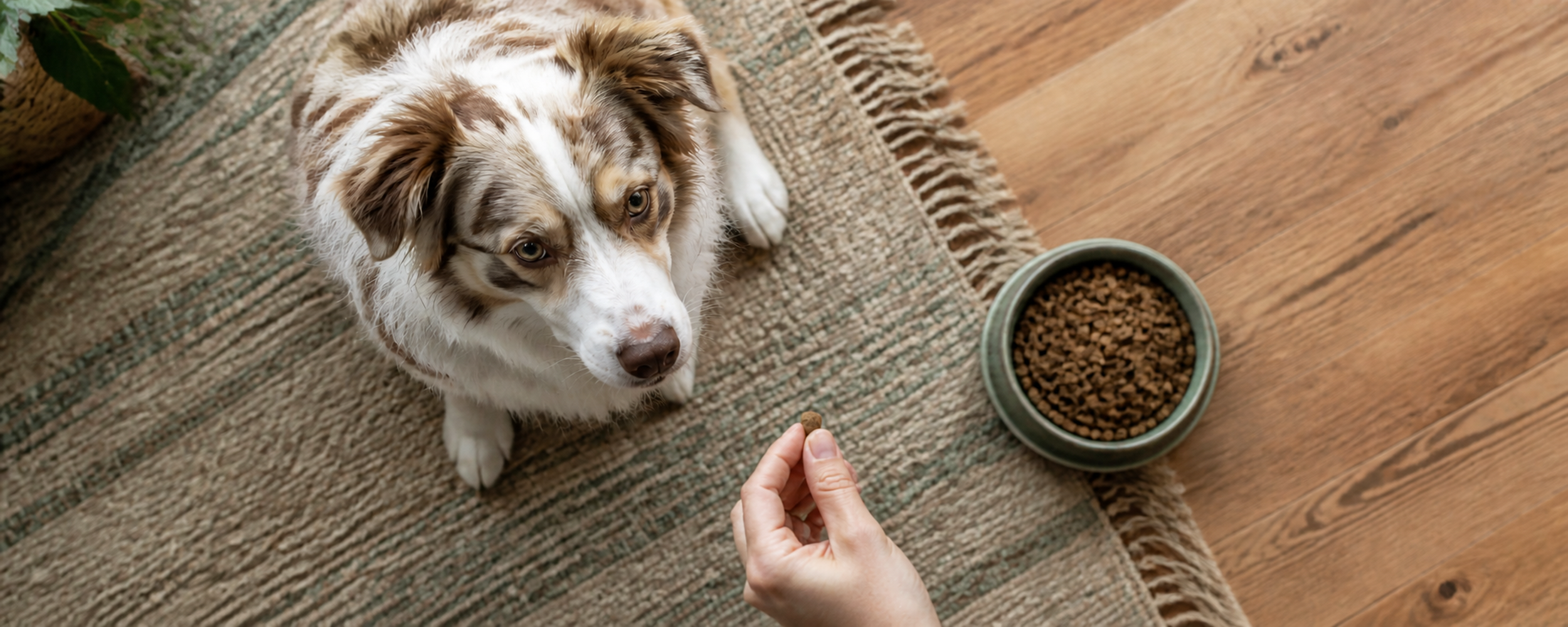
The bowl goes down. Your dog sniffs it, looks at you, and walks away.
Ten minutes later, a treat appears—and suddenly their appetite is perfect.
It is tempting to call this stubbornness. It is just as tempting to panic and assume something is seriously wrong. But “won’t eat dinner, will eat treats” can come from several very different situations, and the treat itself does not tell you which one you are seeing.
The useful question is not simply, “Will my dog eat?”
It is: What will they eat, how do they eat it, and what else changed?
A treat is not a clean bill of health
Treats are usually smellier, richer, smaller, and more exciting than a regular meal. A dog with mild nausea, stress, or discomfort may still accept a high-value bite even when a full bowl feels unappealing.
There is also a difference between not wanting to eat and wanting to eat but finding it uncomfortable. Veterinary sources sometimes describe the second pattern as “pseudo-anorexia”: the dog is interested in food but has trouble picking it up, chewing, or swallowing it.
That distinction can show up in small details:
- They approach the bowl, then back away.
- They take food but drop pieces.
- They chew slowly or only on one side.
- They prefer soft food and refuse hard kibble or chews.
- They drool, paw at the mouth, or resist having their face touched.
- They seem hungry but stop after a few bites.
Dental pain is one possible explanation, but not the only one. Nausea, pain elsewhere in the body, stress, a changed routine, medication effects, an unappealing food, and other medical problems can also reduce normal eating.
So “they ate a treat” proves only that the treat was appealing enough to accept. It does not prove that the dog feels fine.
Sometimes the dog has learned to wait for the upgrade
There is another common possibility: the bowl has become the opening move in a negotiation.
The dog skips kibble. The owner worries. Chicken appears. The next day, the dog waits for chicken. Soon chicken is no longer enough, so it becomes cheese, a new topper, hand-feeding, or another bag of food.
No one deliberately teaches this pattern. It grows out of concern. Refusing the first offer reliably produces something better, so waiting becomes worthwhile.
That does not mean every selective dog is “manipulating” their owner, and it should never be used to dismiss a sudden appetite change. It simply means behavior can become part of the problem after pain, illness, and other changes have been considered.
One clue is consistency. A dog who has followed the same dinner ritual for months, maintains a stable weight, behaves normally, and enthusiastically accepts preferred foods may be showing a learned preference. A dog whose eating changed suddenly—or whose selectivity arrives with vomiting, diarrhea, weight loss, low energy, restlessness, drooling, bad breath, or trouble chewing—deserves a different level of concern.
Before buying another food, make a one-day record
Memory compresses a messy day into “they barely ate.” A short written record is much more useful.
For the next 24 hours, note:
- The exact food offered, amount, and time.
- How much was actually eaten.
- Every treat, chew, topper, table scrap, and food used for medication.
- Whether the dog approached the bowl or ignored it.
- Whether chewing looked normal.
- Water intake that seemed clearly different from usual.
- Vomiting, retching, diarrhea, constipation, grass-eating, drooling, or repeated swallowing.
- Energy, restlessness, hiding, or unusual clinginess.
- Any recent food change, medication, travel, visitors, boarding, heat, or disruption to routine.
This is not about diagnosing your dog at home. It is about replacing the label “picky” with observations a veterinarian can use.
It may also reveal that the dog ate more than it seemed. Treats, dental chews, toppers, scraps, and medication foods all count. AAHA recommends looking at the complete diet history, not just what goes into the main bowl; treats and other extras should generally stay within 10% of total daily calories so the main complete-and-balanced food remains the nutritional foundation.
Read the pattern, not the performance
A dog can perform enthusiasm for one bite while still having an eating problem. Pay attention to the pattern across meals.
More consistent with an upgrade loop: the behavior is longstanding, weight and energy are stable, chewing looks comfortable, there are no other symptoms, and refusing the bowl predictably produces better food.
More concerning for discomfort or illness: the change is new, the dog wants food but struggles with it, preferred foods are also being refused, intake keeps falling, weight is changing, or other physical or behavioral signs appear.
Those categories can overlap. A dog may have learned to expect toppers and later develop dental pain. A stressful week can reduce appetite and also lead an owner to create a more elaborate feeding ritual. That is why a clean timeline is more reliable than testing the dog with increasingly tempting foods.
If medical concerns are low, make dinner predictable again
Once your veterinarian has helped rule out a health problem—or if this is a familiar, mild pattern in an otherwise well dog—consistency matters more than creativity.
Use a complete-and-balanced food appropriate for your dog, keep meal times reasonably predictable, and make sure everyone in the household follows the same plan. Count training rewards and chews as part of the daily food picture. If you use toppers, decide on a consistent amount rather than escalating them each time the dog hesitates.
Avoid changing foods repeatedly just to win one meal. Sudden switches can upset the digestive system, while constant novelty can make it harder to see what the dog actually tolerates. If a diet change is needed, your veterinarian can help you choose the food and transition plan.
The goal is not to “out-stubborn” the dog or stage a hunger contest. Puppies, small dogs, seniors, and dogs with medical conditions may have less room for missed meals. The goal is to stop improvising long enough to see the pattern clearly.
When to call the veterinarian
Get veterinary guidance early for a sudden or persistent change in eating, especially if your dog is very young, elderly, underweight, or managing another condition.
Seek more urgent care when appetite loss appears with repeated vomiting or retching, a swollen or painful abdomen, marked weakness, collapse, trouble breathing, suspected toxin or foreign-object exposure, inability to keep water down, or significant pain.
Also call if your dog seems eager to eat but cannot chew or swallow normally. Interest in food does not make mouth, throat, or dental pain less real.
If you are unsure how long it is safe to monitor, call your veterinary clinic and describe the dog’s age, size, medical history, last normal meal, current intake, and accompanying signs. That is safer than relying on a universal waiting rule.
Make the next conversation more specific
If you use Petal, its nutrition plan and structured pet profile can keep food entries, weight history, allergies, conditions, and medications together. That will not tell you why your dog skipped dinner, but it can help you show your veterinarian whether the “picky” episode followed a food change, accompanied a weight shift, or sits inside a larger health pattern.
The best outcome is not proving that your dog is fussy—or proving that they are sick.
It is noticing when dinner became different, and bringing better evidence to the person who can determine why.
Sources
- VCA Animal Hospitals, Anorexia in Dogs
- VCA Animal Hospitals, Dental Pain in Dogs
- American Animal Hospital Association, Nutritional Risk Factors
- American Animal Hospital Association, Feeding Plans for Healthy, Appropriate Weight Cats and Dogs