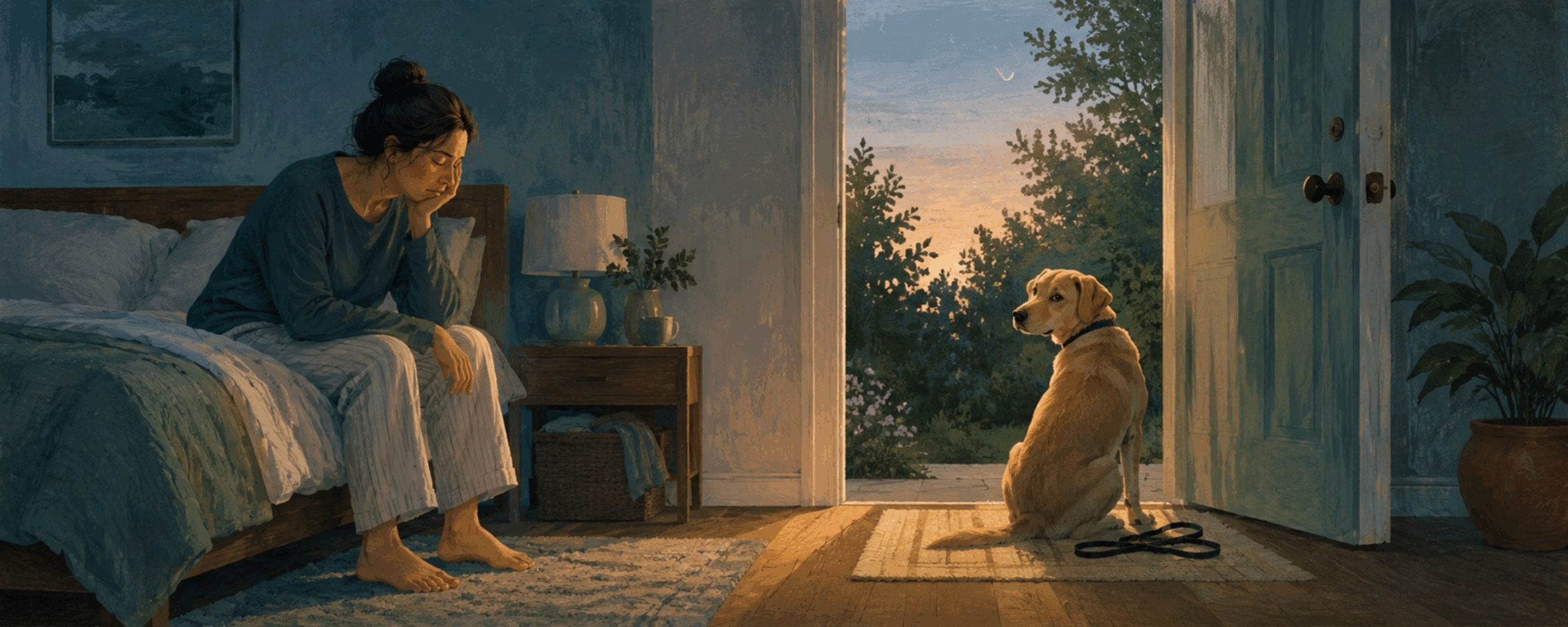
At 3:07 a.m., your dog paws at the bed.
You let them outside. They pee, come back in, and settle down.
Then it happens again the next night. And the night after that.
It is easy to label a new nighttime wake-up as attention-seeking, hunger, or a routine that needs stricter training. Sometimes it is. But a dog who suddenly needs to go out at night may also be drinking more, producing more urine, feeling urinary discomfort, or developing another health problem.
The useful first question is not, “How do I make my dog stop waking me?”
It is: What changed, and what exactly happens after the door opens?
Start with the bathroom part
The most useful clue is whether your dog actually urinates—and what that urination looks like.
For the next few nights, notice:
- Does your dog wake you urgently or wander around before you notice?
- Do they produce a normal stream, a small dribble, or nothing?
- Do they settle immediately after coming back inside?
- Are they also waking to eat, drink, play, or seek contact?
- Is the new wake-up happening at the same time each night?
- Has your dog had an indoor accident or leaked urine while asleep?
A dog that goes outside, produces a normal amount, and immediately returns to sleep may be showing a schedule change, a learned habit, or a response to a later meal or extra evening water.
A dog that repeatedly asks out, strains, produces only tiny amounts, drinks more, or cannot settle afterward is giving you a different set of clues.
One isolated night is not a diagnosis. A new pattern that continues is worth recording rather than guessing about.
Make a short log before you try to train it away
Memory turns several messy nights into “he keeps waking me up.” A simple record gives you and your veterinarian something more useful.
For 48–72 hours, write down:
- The time your dog woke you
- Whether they asked to go out, seemed restless, or woke for food or attention
- Whether they urinated, and whether the amount looked small or normal
- Any straining, discomfort, blood, unusually strong odor, or repeated licking around the urinary opening
- How much water was consumed, or how often the bowl needed refilling
- Any daytime accidents or urine leakage while sleeping
- Meals, treats, chews, and unusual snacks
- Medications and supplements, including any recent change
- Appetite, vomiting, diarrhea, panting, energy, and obvious weight change
If multiple pets share a water bowl, you may not be able to measure one dog’s intake precisely. You can still note whether the bowl is empty more often, whether your dog seeks water elsewhere, or whether the dog is asking out more frequently than usual.
Do not restrict water to reduce nighttime trips. A dog who is genuinely thirstier may need that water, and restricting it can cause dehydration or dangerous electrolyte problems. More frequent, comfortable bathroom breaks are safer while you arrange veterinary advice.
When a new nighttime trip can be a body signal
Veterinarians often group increased drinking and increased urination together as PU/PD. Cornell notes that owners may first notice a water bowl that needs filling more often, more frequent requests to go outside, accidents in the house, or urine leakage during sleep.
There are many possible causes, including urinary infection, diabetes, kidney disease, adrenal-gland disorders such as Cushing’s or Addison’s disease, liver disease, and—among unspayed females—uterine infection. Heat, pain, and stress can also change drinking and urination.
That list is not a diagnosis checklist. It is a reason not to dismiss a sudden change as bad behavior.
Pay particular attention when the nighttime wake-up arrives with:
- Increased thirst or a noticeably emptier water bowl
- Weight loss despite a normal or increased appetite
- Reduced appetite, vomiting, diarrhea, or unusual weakness
- More panting than usual
- Accidents or leaking urine while asleep
- A change in how long your dog takes to urinate
- A dog who seems painful, restless, or unable to get comfortable
If your dog is an unspayed female and the change occurs a month or two after a heat cycle—especially with lethargy, poor appetite, vomiting, vaginal discharge, a swollen belly, or increased thirst—call a veterinarian promptly. Pyometra, a uterine infection, can become life-threatening.
The urine pattern matters more than the clock
A 3 a.m. bathroom trip is not automatically alarming. The pattern around it matters more.
More consistent with a schedule or learned routine:
- The wake-up has happened for a long time
- The timing is predictable
- Your dog urinates a normal amount
- Water intake, appetite, weight, and daytime behavior are unchanged
- Your dog settles after a quiet bathroom break
More concerning for discomfort or illness:
- The change is new or getting more frequent
- Your dog makes repeated attempts but passes little urine
- They strain, cry, lick the area repeatedly, or appear painful
- They drink more or seek unusual water sources
- They have accidents despite being reliably house-trained
- They leak while sleeping
- They also show appetite, weight, energy, vomiting, diarrhea, or panting changes
These categories can overlap. A dog can have a well-established early-morning habit and still develop a urinary problem. A dog can also wake because dinner or water shifted later, then learn that waking reliably produces attention.
That is why “it is probably behavioral” is not a useful first conclusion when the behavior changed suddenly.
When the wake-up may be about attention, food, or routine
Once health concerns are low—or a veterinarian has helped rule them out—routine may be part of the explanation.
Some dogs wake because the household schedule changed. A later dinner, a new bedtime snack, a different work shift, warmer weather, or extra evening play can shift when they need to eliminate. Others discover that scratching at the door produces a walk, food, petting, or an exciting conversation.
If your dog goes out, urinates normally, and immediately wants to play or eat, keep the trip calm and boring. Use the same brief cue, return inside, and avoid turning 3 a.m. into the most rewarding event of the day.
Do not punish accidents or force a dog to hold urine longer. The goal is a predictable routine after you have considered medical causes—not a contest to see who can wait the longest.
Puppies, seniors, and dogs with existing medical conditions may need more frequent breaks than a healthy adult dog. A universal “your dog should hold it this long” rule is less useful than your dog’s normal pattern and current health.
Know when it is urgent
Contact a veterinarian promptly for a new or persistent change in drinking, urination, or nighttime bathroom needs.
Seek urgent care if your dog repeatedly strains but cannot pass urine, collapses, becomes severely weak, has a painful or swollen abdomen, repeatedly vomits, has significant blood in the urine, or cannot keep water down. Inability to urinate can be an emergency.
When you call, have the log ready. Include your dog’s age, sex and spay/neuter status, last normal night, current water and urine pattern, medications, appetite, and any other changes. A veterinarian may recommend an examination, urinalysis, bloodwork, and sometimes imaging to find the cause.
Make the pattern easier to see
The nighttime wake-up is not the whole story. It is one event in a timeline.
If you use Petal, you can keep the wake-up time, water and bathroom changes, medication reminders, weight trend, and related notes together. That will not diagnose why your dog needs to go out, but it can make the change easier to describe accurately when you speak with your veterinarian.
The best next step is not automatically a stricter bedtime routine or a new training plan.
It is noticing whether your dog’s night changed because the schedule changed—or because your dog’s body did.
Sources
- Cornell Richard P. Riney Canine Health Center, “Canine Polyuria and Polydipsia (PU/PD)”: https://riney.vet.cornell.edu/member-benefits-health-tips/polyuria-polydipsia-april-2024
- Cornell University College of Veterinary Medicine, “Diabetes in Dogs”: https://www.vet.cornell.edu/departments-centers-and-institutes/riney-canine-health-center/canine-health-information/diabetes-dogs
- Cornell University College of Veterinary Medicine, “Cushing’s Syndrome”: https://www.vet.cornell.edu/departments-centers-and-institutes/riney-canine-health-center/canine-health-information/cushings-syndrome
- Cornell University College of Veterinary Medicine, “Pyometra”: https://www.vet.cornell.edu/departments-centers-and-institutes/riney-canine-health-center/canine-health-topics/pyometra
- Reddit owner discussion, “Is early-morning dog wakeups something you can train?”: https://www.reddit.com/r/dogs/comments/1qce9e6/is_earlymorning_dog_wakeups_something_you_can/